The weeks between Thanksgiving and New Year’s are the busiest time of year for giving. Churches, schools, clubs, and local nonprofits across Palm Beach, Broward, and Miami Dade County run toy drives, food drives, and holiday fundraisers, and every one of them wants the same thing: more people showing up. Entertainment is one of the simplest ways to make that happen.
A mobile game truck gives volunteers a draw that families recognize right away. Children ask to go, parents bring a donation, and the event becomes more than a drop off table. Organizers get a crowd, donors get an afternoon they enjoy, and the cause gets more support.
How a Game Truck Helps a Charity Event
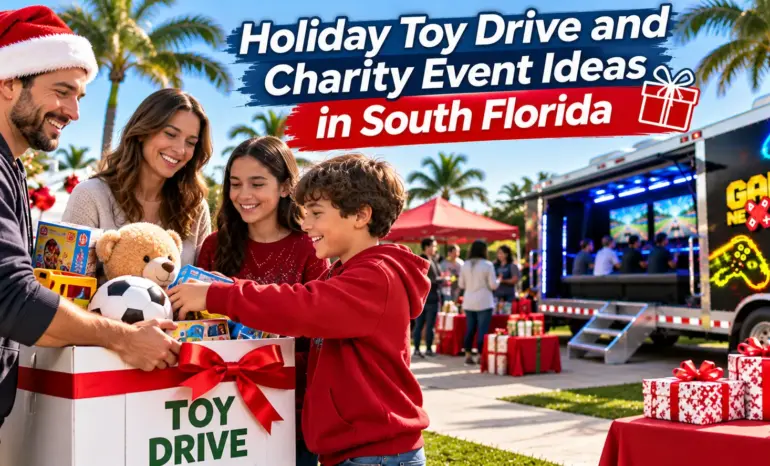
Many drives struggle with the same problem. People mean to donate, but busy schedules get in the way. A fun event gives them a reason to stop by. A truck parked in the lot with a sign that says one new toy equals one game turn creates an instant incentive, and families walk away feeling good about giving.
- Draws families who might otherwise skip the drive
- Creates a natural exchange of one gift for one turn
- Keeps children entertained while adults talk with volunteers
- Generates photos and social posts that spread the word
Event Formats That Work
Organizers usually choose from a few proven formats. The first is a toy for play model, where every donated toy earns a turn. The second is a ticketed family night, where proceeds support the cause. The third is a volunteer appreciation event, where a truck rewards the people who gave their time.
- Bring a toy, play a round
- Ticketed family night with food and games
- Volunteer and donor appreciation day
- Holiday carnival with multiple stations
Churches and Community Groups
Faith communities are some of the most active organizers of holiday drives. A game truck fits naturally into a parish hall lot, a synagogue parking area, or a church campus. Youth groups often love the format because it gives teenagers a reason to volunteer and a reward for helping.
See how church groups use the truck in our youth group guide.
Schools and PTAs
Schools run toy and book drives that benefit local families. A truck can serve as the reward for the class that collects the most items, or as the centerpiece of a family night where students deliver their donations in person. Staff members can plan a schedule with rotations so every class has a turn.
Nonprofits and Small Businesses
Small businesses often partner with nonprofits to host a drive at their location. A restaurant or gym might offer a discount on food for anyone who donates, and the truck adds energy to the lot. The business gets customers, the nonprofit gets toys, and the neighborhood gets a lively event. Be sure to confirm parking, permits, and insurance requirements before announcing the date.
Planning Checklist
A little preparation goes a long way. Choose a date and time that avoids major holiday conflicts. Confirm the location, parking surface, and any permission needed from the property owner. Set a clear donation goal and communicate it in advance. Assign volunteers to greet guests, collect items, and manage a sign in sheet.
- Pick a date at least three weeks before the final delivery day
- Confirm the parking surface and any property approvals
- Promote through schools, churches, and social channels
- Assign volunteers to greet, collect, and track donations
- Plan for a thank you message and photo after the event
Budget and Sponsorship
Some groups cover the booking through a local sponsor. A business may underwrite the truck in exchange for a banner or a mention in the event announcement. Others set a small admission fee. Either way, the cost can often be recovered through donations and increased attendance.
Ask the team about options for nonprofits and plan the event around what fits your budget.
Use the cost guide to estimate expenses before you approach sponsors.
After the Event
Count the donations, thank the volunteers, and share the results. A short post with photos and totals keeps supporters engaged and makes it easier to recruit help next year. Many organizations find that a well run event becomes an annual tradition.
Real World Example of a Simple Drive
Consider a neighborhood group that wants to collect two hundred toys for a local shelter. They pick a Saturday in mid December, choose a church lot as the site, and announce a one toy, one turn rule. Volunteers greet guests at a donation table while a truck runs rotations in the background. Families arrive, drop off a toy, play, and leave with a sense of accomplishment. By the end of the afternoon the table is full, the volunteers are tired in the best way, and the group has a template to repeat next year.
The key ingredients are simple: a clear goal, a visible location, and an activity that makes people want to stay.
Making Giving Meaningful for Children
Children who donate a toy and then play a game learn that giving and fun are connected. Parents can talk with them before the event about choosing a gift for another child. Some schools ask students to write a short card to go with each toy. These small steps turn the event into a lesson in generosity as well as a party.
Safety and Permissions
Public events carry responsibilities. Confirm that the property owner approves the activity, check whether your city requires a special event permit, and ask about insurance expectations for volunteers and vendors. Place the truck where traffic is easy to manage, and mark a clear walkway for families. If your group works with minors, follow your organization’s policies on supervision and background checks.
A short planning meeting with all volunteers a few days before the event helps everyone understand their roles and keeps the day running smoothly.
Promoting the Event
Use every channel you have. Flyers at schools and churches, posts in neighborhood groups, and a short message on local community boards all help. Include the date, address, and what to bring. Mention that children can play after donating, and share a photo of the truck so people know what to expect. A clear message and an early start on promotion make the difference between a quiet table and a full lot.
- Flyers in schools, churches, and community centers
- Posts in neighborhood and parent groups
- Local business partners sharing the message
- Reminder posts the day before and the morning of the event
Frequently Asked Questions
Can you support a nonprofit event?
Yes. Contact the team with your date, location, and goals to discuss options.
Does the truck work in a church or school parking lot?
Yes. It needs a flat surface and has its own power.
How do we tie games to donations?
Many groups use a one toy, one turn model or give tickets to donors.
How long should the event run?
Two to three hours is common, with a rotation that lets many families participate.
Do we need special permits?
That depends on the property and city. Check with the owner or local office when planning.